User research has long involved a tradeoff between depth and scale. In-depth interviews uncover the motivations behind user behavior, but they are time-intensive and only reach a small number of participants. Surveys and unmoderated usability tests, on the other hand, can scale to hundreds of participants but cannot ask the follow-up questions that often turn a surface-level response into a meaningful insight.
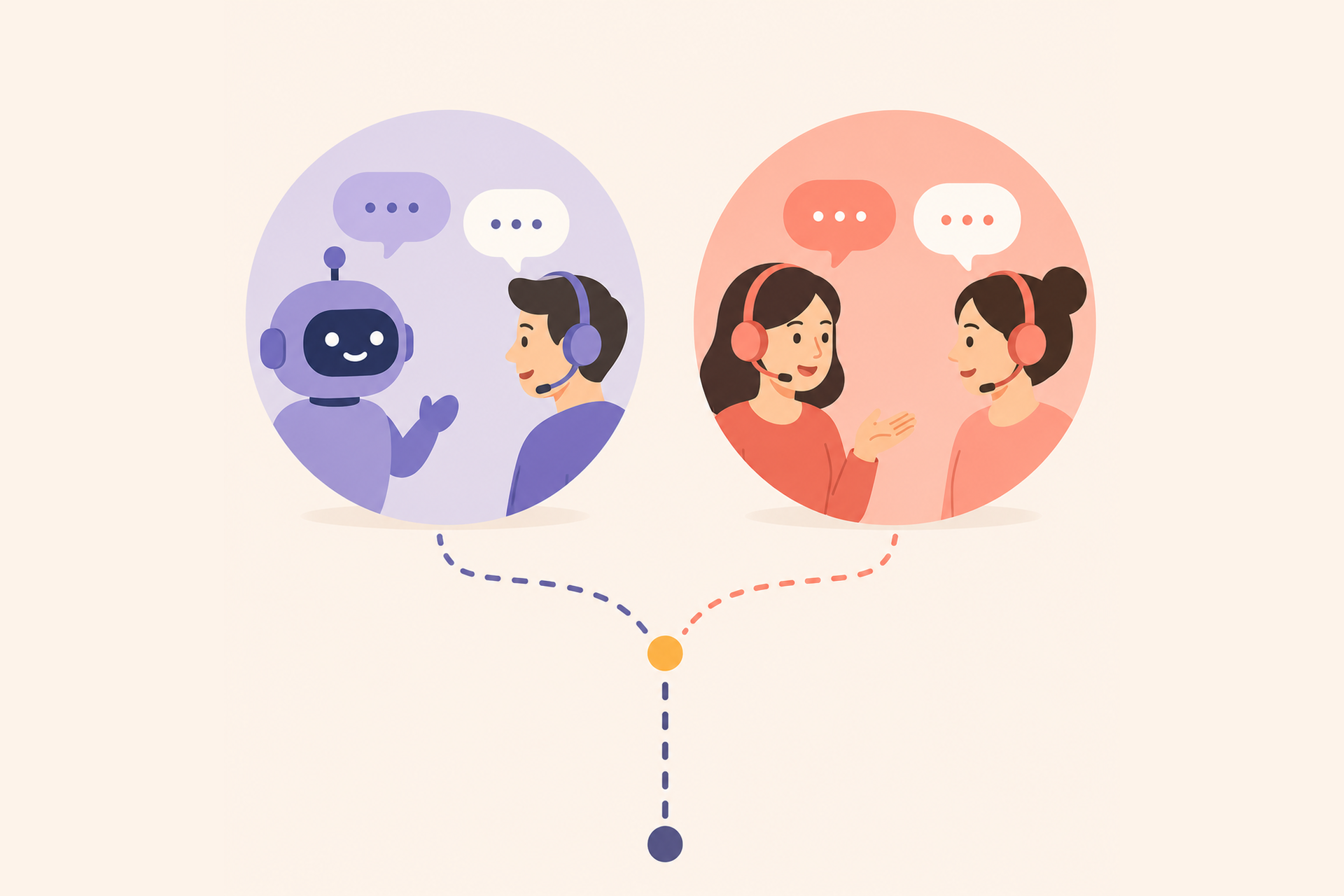
AI moderated interviews, also known as AI-led interviews, are designed to bridge that gap. Instead of relying on a human moderator, a large language model conducts the interview, adapting its questions in real time based on each participant's responses while running many sessions simultaneously.
This guide is for product managers, UX researchers, and design teams evaluating whether AI moderated interviews fit their research workflow. We'll explain what they are, where they work best, their current limitations, and how to run an AI moderated interview study using a platform like Hubble.
What is an AI moderated interview?
An AI moderator is an AI agent that is configured with your research goals and discussion guide, and runs the interview without a human moderator. It asks your questions, evaluates each response as it arrives, and decides in real time whether to probe further, ask a clarifying question, or move on. Sessions run asynchronously, allowing participants to take part on their own schedule while you conduct many interviews simultaneously. This can help teams collect conversational insights quickly across regions.
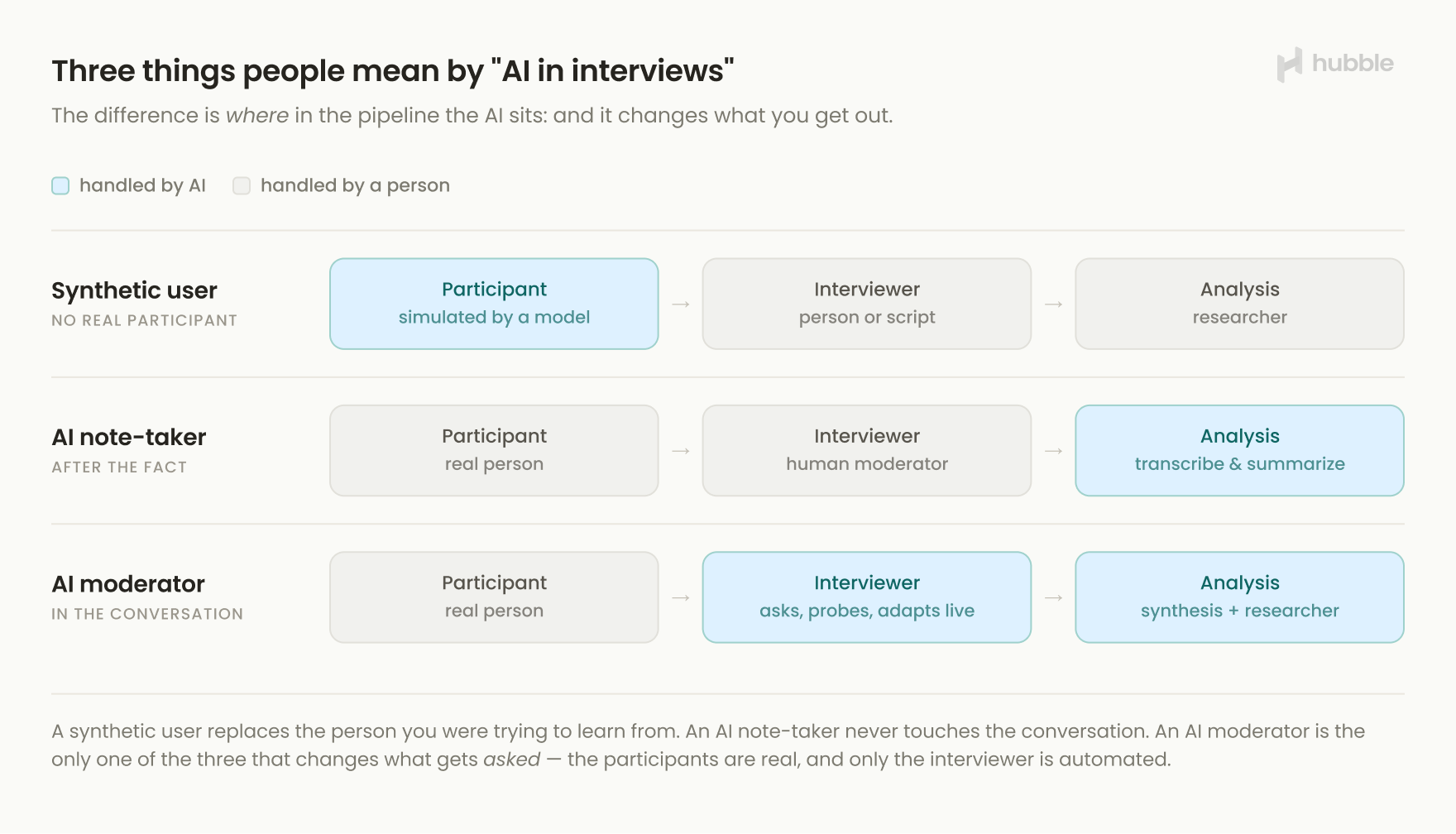
Two concepts are frequently confused with AI moderation, and that confusion often leads teams toward the wrong research approach.
The first is a synthetic user: a language model that replaces participants entirely, allowing teams to skip recruitment. AI moderation is the opposite. The participants are real people who have used your product or experienced the problem you're researching; only the interviewer is automated.
The second is an AI note-taker. AI note-takers transcribe, summarize, and analyze interviews after a human moderator has already conducted the session. They improve analysis, but they don't influence the conversation itself. An AI moderator, by contrast, actively conducts the interview. It listens, adapts, asks follow-up questions, challenges vague responses, and uncovers the reasoning behind what participants say in real time.
On Hubble, the AI moderator guides each conversation naturally, asks intelligent follow-up questions, and continuously adapts based on each participant's responses without anyone needing to observe the session live. You define the discussion guide, the moderator's personality and tone, and the target interview length, giving you complete control over the research experience while allowing every conversation to adapt dynamically to uncover richer, more meaningful insights.
How an AI moderator works
The adaptability of AI-moderated interviews comes from the agentic AI technology that powers them. At its core is a large language model (LLM) — the same class of artificial intelligence behind tools like ChatGPT and other modern AI assistants. Rather than following a rigid decision tree or matching keywords against predefined rules, the AI understands responses as natural language. It interprets what a participant means, evaluates that response against your research objectives, and determines the most appropriate next question in real time.
Because it reasons about language instead of executing a fixed script, an AI moderator can respond intelligently to answers it has never encountered before. If a participant gives a vague response, it can ask for clarification. If they reveal something unexpected, it can explore that new line of inquiry. If they only partially answer a question, it can probe further before moving on. Every interview evolves based on the participant's responses, allowing the conversation to adapt naturally while remaining aligned with your research goals. Traditional surveys and scripted unmoderated tests cannot do this — they can only present the questions that were written in advance.
This capability allows the AI moderator to recognize ambiguity, identify inconsistencies, distinguish complete answers from evasive ones, and understand context across an entire conversation rather than treating each response in isolation. As the interview progresses, it builds on what has already been said, enabling more thoughtful follow-up questions and richer qualitative insights than a static questionnaire can produce.
At the same time, these strengths also define the technology's boundaries. A large language model is exceptionally good at understanding and reasoning about the information participants provide, but it can only work with what is expressed during the interview. It cannot infer facts that were never shared, verify assumptions beyond the conversation itself, or replace the judgment of an experienced researcher.
What AI moderation is good at, and what that buys you
Strengths only matter if your study is the kind that can use them. Each of the capabilities below unlocks a specific kind of work, and it's worth reading them as pairs rather than as a feature list.
Scale without scheduling
Traditional moderated research is limited as much by logistics as by the interviews themselves. Researchers spend time coordinating calendars, accommodating time zones, managing cancellations, and recruiting enough moderators to conduct sessions.
AI moderation removes those constraints. Interviews run unattended, allowing participants to complete sessions whenever it is convenient for them, while hundreds of interviews take place simultaneously. Instead of spending weeks coordinating schedules, research teams can complete an entire study in a matter of days.
This is what makes post-launch feedback practical. You can gather reactions across every market within days of a release, while it is still fresh, rather than working through one region at a time with a moderator in each. Participants can complete interviews in their native language without requiring multilingual researchers or separate moderation teams, which matters for global launches, international customer research, and early concept validation where feedback from multiple markets is needed inside the same research cycle.
Consistency across sessions
Every participant receives the same core interview structure. The interview guide remains consistent while the follow-up questions adapt to each individual's responses.
Human moderators naturally vary their wording, emphasis, and probing style from one interview to the next. Those small differences can introduce unintended bias and make interviews harder to compare. AI moderation reduces that variability by applying the same research framework to every participant while still allowing each conversation to develop naturally.
That consistency is what makes tracking studies work. The wording holds steady wave to wave, so the numbers stay comparable over months rather than drifting with whoever ran the sessions that quarter.
Adaptive Follow-ups
The defining characteristic of AI moderation is its ability to adapt the conversation as it unfolds. Rather than following a predetermined script, the moderator continuously evaluates each response and decides what to ask next. If a participant gives a vague answer, it asks for clarification. If they introduce an unexpected insight, it explores that direction. If they have already addressed a topic, it moves on instead of asking redundant questions. On Hubble, the moderator adjusts both the depth and style of its questioning to match the study, exploring broad attitudes during discovery research or focusing on specific usability issues during product evaluations.
It is worth being precise about what that adaptation does and does not do, because the line does not run where you might expect. It is not about whether an answer surprises you. If a participant brings up something you never anticipated, the moderator can follow it. What it cannot do is raise what no one has said. An AI interview expands and sharpens what participants put on the table, but it will not open ground they were not heading toward on their own. The test for whether that is enough comes down to a single question. Can you say in advance what is worth asking about? When you can, the model has something to work from.
Concept and feature feedback is the clearest example, and it is everyday work for most UX research teams. Participants have something specific in front of them, you know what you need to learn, and a short adaptive interview pulls more than a survey would on the same prompts. Screening participants works the same way, since it is evaluative and scripted by nature, and it frees a researcher from a task that drains hours.
What ties all of this together is a known question inside a problem space you already understand. The payoff is reach and speed. What you give up is the question that nobody thought to put in the guide and that no participant volunteered on their own. For this kind of work, that is a fair trade.
Connecting Behavior With Motivation
One further strength emerges when interviews are integrated directly into product research workflows rather than run as a standalone method.
On Hubble, AI-moderated interviews can be combined with prototype tests, usability studies, live website testing, and in-product surveys within the same study. Researchers can observe exactly what participants did and immediately ask why they did it.
This combination is powerful because people are often imperfect reporters of their own behavior. What participants say they did and what they actually did are not always the same. By capturing behavioral data alongside adaptive qualitative interviews, researchers gain a more complete understanding of both user actions and the reasoning behind them — without having to stitch together findings from separate research tools afterward.
Where AI moderation falls short, and how to work around it
That trade, reach and speed in exchange for the unexpected, only holds if you know where the method strains. Some of what follows is a rough edge you can plan around. Some of it is a hard line. Both are worth knowing before you field.
It only knows what you tell it
Left alone, an AI moderator works only from the questions in front of it. It will press a thin answer, but without a sense of who it is talking to, the follow-ups stay generic.
Context is the fix. When the model has the participant's persona, the study goal, and the constraints it works under, its questions sharpen and land on what matters to the study instead of asking in the abstract. Hubble lets you add that context on top of the discussion guide.
The tone can turn too agreeable
Models often run warm to a fault. They thank and affirm a participant until it sounds insincere, and that flattery flattens honest feedback. The guide helps here. Neutral wording gives the model less to echo, but it will still praise on its own, so a pilot is where you actually catch it. Run a few sessions, listen for where the model goes soft, and tell it plainly not to evaluate or encourage before you take the study wide.
Depth has a ceiling
The same line that makes adaptation reliable also caps it. Every follow-up starts from something a participant has already said, so a session only goes as deep as their own answers lead. For the structured, evaluative work the method is meant for, that is the depth the job needs. When you need more, the fix is not a better prompt. It is a person.
When to keep a person in the loop
Some work has no workaround. If you cannot say in advance what to probe for, the model has nothing to hold onto.
Open-ended discovery is where that bites first. Mapping a space no one understands yet means following the answers you did not anticipate, and a model working only from your guide walks past them. Emotionally charged research is another. Sensitive personal topics, or a vulnerable participant, need rapport and the judgment to ease off in the moment, and a misread lands on the person rather than the data. Deep expert interviews turn on domain fluency the model lacks, so it misses the term of art and the answer that deserved a harder push. High-stakes work is different in kind again. When a major decision rides on the findings, or the relationship with the participant is worth something on its own, a person should sit in the chair whether or not a model could manage the questions.
The teams that get the most out of AI moderation treat this as a division of labor, not a defeat. The model covers breadth at speed, and a researcher goes deep where the study needs it. On Hubble both run in one place and draw from the same participant pool, so the deep sessions start from what the AI already surfaced instead of a blank page and a fresh recruit.
How to run an AI moderated interview study
The process mirrors any sound interview study, with a few adjustments once a model is holding the conversation.
- Define what you want to learn. The goal decides whether AI moderation fits at all, and it keeps the guide tight, which matters more for a model than for a person who can correct course alone. A study built around a clear, answerable question tends to run well. One built around open exploration tends not to.
- Write the discussion guide, and give the AI context. The guide steers everything, so keep questions neutral, open broad before narrowing, and hold the topic count down, since a model handles a few well-scoped topics better than many shallow ones. Beyond the guide, you can give the model context on the participant and the goal, which Hubble supports, and the follow-ups land at the right level from the first question.
- Recruit participants. Set your criteria before fielding, so you collect relevant sessions rather than clean up irrelevant ones after. Hubble connects to enterprise participant pools like User Interviews and Respondent, with access to more than five million people and targeting for consumers and industry professionals alike, or you can bring your own list.
- Pilot, then field. Run it with a few people first, watch where the model stalls or repeats itself, and fix the guide rather than the participant.
- Review with a human in the loop. Running at scale, some sessions come back thin. A participant rushes, or misreads the prompt, and the summary skews unless you read for the ones to set aside. What the findings mean, and what to do about them, stays with the researcher.
Getting honest answers from participants
The quality of an AI interview rests on the participant as much as the model, and a few things move it.
Tell people up front that the interviewer is an AI. Hiding it backfires when they work it out mid-session, and naming it sets the right expectation. Keep the session short, twenty to thirty minutes. Attention drops on a screen faster than it does with a person in the room, and a rushed final third is where thin answers collect. Write the guide in plain, neutral language, since a model will not rephrase a confusing question on instinct the way a person would.
There is a quieter effect here. Some participants say more to an AI than to a person, since there is no one to read judgment from, which helps with the small awkward things people gloss over face to face. It does not extend to sensitive or high-stakes subjects, where the missing person is a loss rather than a relief. Treat it as something to check in a pilot, not a reason to reach for AI on hard topics.
Turning interviews into findings
A round of interviews is raw material. Getting from there to a result is where a platform pulls its weight. Every session on Hubble is recorded and transcribed, so nobody is taking notes while trying to listen. Its AI synthesis then reads across all of them and pulls out the recurring themes and the quotes that carry them, which turns a stack of transcripts into a first draft of the findings in a fraction of the time it would take by hand.
That draft is a starting point. A researcher still reads it against the goal, decides what holds and what is noise, and shapes it into something the team can act on. The synthesis speeds up the reading. It does not stand in for the judgment. Keeping the findings in one place to share also means the work does not stall while someone rebuilds it into a deck.
When should you use AI, a human, or both?
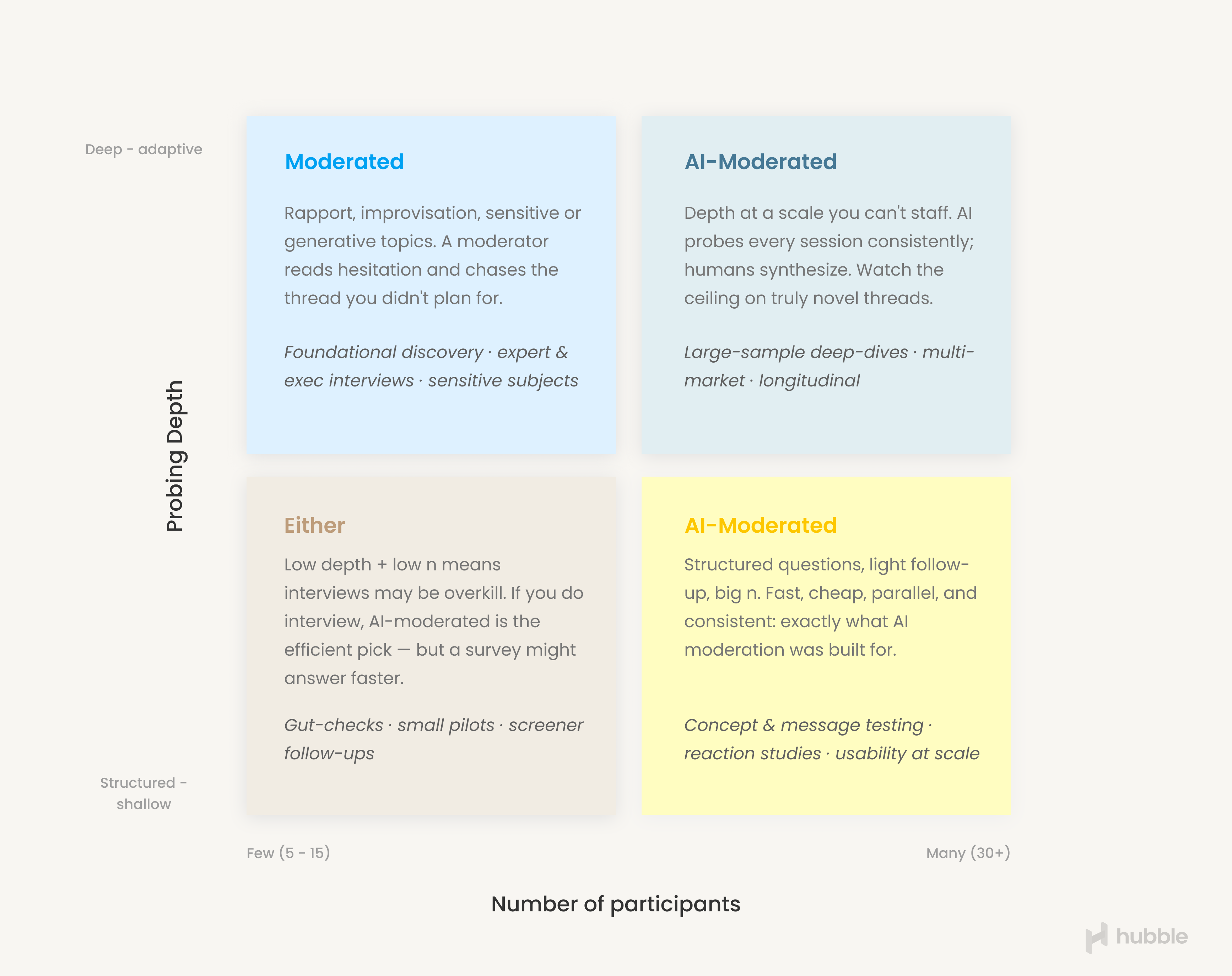
Two questions settle most cases. Is the problem space already understood, and is the goal to evaluate or to discover?
A familiar space with a structured, evaluative goal points to AI moderation. An open space, or a goal of finding what you do not yet know, points to a person. A few conditions override the goal on their own. An emotionally charged topic, a decision that carries real weight, or data that cannot leave for a third-party model settles the choice regardless of how well you understand the space. The data case is the one teams miss most, since it has nothing to do with how sensitive the subject feels. A routine study in a familiar space can still be bound by where its data is allowed to go.
For most ongoing research the answer is both, with AI widening the base and people going deep where the work is hardest. None of this is fixed for good. The tools are moving quickly, and the line between what a model can carry and what still needs a person keeps shifting, so the split is worth revisiting as the method changes.


FAQs


No. It takes on the structured, scalable interviewing and frees researchers for the discovery and synthesis that still need them. It complements human moderation rather than replacing it.
It depends on the platform and how you recruit, since participant incentives and panel access usually drive the bill more than the software does. The method's own advantage is that unattended, parallel sessions cut the per-interview cost of moderator time, which is where traditional interviews get expensive.
No. The participant is a real person who used the product or lived the problem, and only the interviewer is automated. The data comes from real experience, not a guess at it.
On Hubble, AI interview data is encrypted in transit and at rest and handled under its compliance program, and you keep control of your research data. For any platform, confirm data handling in the vendor's terms before running sensitive research.


.png)