Understanding the difference between generative and evaluative research helps researchers and designers know what to explore and when to test.
Generative research is about uncovering and identifying user needs to generate insights that serve as the foundation for understanding your user base and guide future product decisions. Evaluative research focuses on assessing whether a proposed concept or design resonates with customers by testing for impact, usability, and overall experience. In short, one helps you build the right thing, and the other helps you build the thing right.
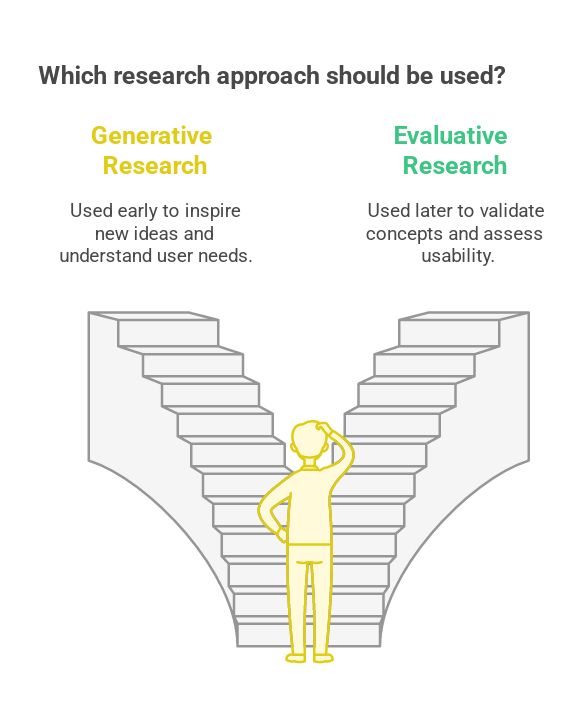
Choosing which approach to use often depends on the stage of your product development cycle. If you’re early in the process and need to identify and validate user needs, or want to uncover opportunities to generate ideas, generative research is the way to go. On the other hand, if you already have a concept or feature ready to test with customers, you’re likely conducting an evaluative study to measure how well it performs.
Knowing which approach to take and when can save time, reduce risk, and lead to stronger design decisions backed by real user insight.
In this article, we’ll unpack what generative vs. evaluative research really means, how they differ, and how they complement each other in modern UX practice. You’ll learn when to use each, what methods fall under them, and how to create a balanced research workflow that supports both discovery and validation.


What is Generative and Evaluative Research?
Generative Research
Generative research, often interchangeably used as discovery research or exploratory research, serves as the foundation of any user-centered design process. Its purpose is to explore, uncover, and understand the why behind user behaviors, motivations, and pain points.
The goal of generative research is to help teams move beyond assumptions. Think of it as the moment you first step into an unfamiliar problem space. You start with desk research to understand the landscape, form early assumptions, and develop hypotheses about your customers. But at this stage, those ideas are still untested. Generative research bridges that gap. It’s a process of discovery: Exploring the space, uncovering patterns, and generating ideas that could eventually shape the right solution for your users.
By learning directly from users, researchers uncover insights about their workflows, challenges, and mental models, building foundational knowledge that guides product strategy and design direction.
Generative studies usually take place early in the product development cycle, during the discovery or ideation phases. They set the groundwork for what will eventually be designed and tested. The output isn’t a prototype or a performance metric, but a clearer understanding of the problem space and the context in which your users operate.
Common Goals of Generative Research
- Uncover user needs, pain points, and motivations
- Identify and fill knowledge gaps about the problem space and customers
- Understand behaviors, workflows, and decision patterns
- Discover opportunities for innovation or unmet market gaps
- Develop early hypotheses for new product concepts
- Build empathy and context for cross-functional teams
Evaluative Research
If generative research helps you discover what to build, evaluative research helps you understand how well it works. Once an idea or concept has been formed, evaluative research comes into play to assess whether the design resonates with users and performs as intended.
The purpose of evaluative research is to test, measure, and validate. It focuses on understanding how users interact with your solution: Identifying what works, what causes friction, and what can be improved before launch. Evaluative studies bring feedback into the design loop, ensuring that product decisions are guided by evidence, not assumptions.
Where generative research looks for possibilities, evaluative research validates design choices, helping teams make informed, evidence backed decisions before investing in full-scale implementation. It's what turns creative ideas into user-tested, reliable solutions: Whether your design meets user expectations, solves a problem more effectively than existing solutions, and whether the overall experience aligns with the intended goals.
Evaluative research typically takes place later in the product development cycle, during the prototyping, iteration, or pre-launch phases. The insights it produces are often actionable and specific: usability issues, satisfaction scores, or task completion rates that inform design refinements.
Common Goals of Evaluative Research
- Gauge product impact: Whether a solution addresses the right problems, and urgency
- Measure usability and efficiency of designs or prototypes
- Assess whether the product meets user expectations
- Identify points of friction, confusion, or inefficiency
- Compare alternative design options to guide decisions
Key Differences: Generative vs Evaluative Research
Generative and evaluative studies each serve different purposes, but they’re deeply interconnected. Together, they create a continuous cycle of learning, in which one moves from discovering opportunities to validating solutions. Understanding how they differ helps you choose the right method at the right time, depending on where you are in the design process.
Here’s a breakdown of how they compare across key dimensions:
Generative research dives into "what problem might we solve"? While evaluative research asks, "how well is our solution working"?
Ericka Hall
How They Complement Each Other
Generative and evaluation research are not opposing approaches. They are complementary phases of end-to-end research cycle. Generative method inspires design directions early in discovery research by uncovering why users behave as they do. Conducting evaluative research measures how well those directions perform in real use.
Teams that balance both gain a richer understanding of their users and stronger confidence in their decisions. Generative insights fuel innovative ideas, while evaluative findings ensure quality and usability. Together, they help you design products that are both meaningful and effective.
When to Use Each Type of Research
Once you know the key details about generative vs. evaluative research, you should know when to use each type of user research method. Knowing when to use each ensures that your team invests effort where it matters the most.
.png)
Use Generative Research When…
You’re still defining the problem or exploring new ideas. This is the time to learn about your users’ goals, frustrations, and mental models before any solutions exist.
- You’re entering a new market or audience segment
- You need to identify and prioritize user needs
- You want to explore different value propositions or product directions
- You’re forming hypotheses for new features or business opportunities
Generative research turns ambiguity into clarity. Conducting generative research early in the design and development process helps you act on the valuable feedback and insights you uncover.
Use Evaluative Research When…
You’ve already designed a concept, prototype, or product feature and need to understand how it performs in the hands of real users.
- You want to validate whether a design meets user needs
- You’re refining usability and clarity before launch
- You’re comparing multiple design options or messaging variations
- You’re tracking improvements across product iterations
- Identify usability issues or friction points for your design solutions
Evaluative research transforms assumptions into evidence. It provides measurable data on what works, what doesn’t, and how users actually experience your design.
How They Work Together
The most effective teams employ both approaches as part of an ongoing feedback loop rather than as isolated steps.
- Start with Generative Research to explore the landscape, identify problems, and generate insights that define your direction.
- Design and Prototype based on your learnings and user feedback.
- Run Evaluative Research to test and refine those designs with users.
- Repeat the cycle: each iteration uncovers new opportunities and new questions to evaluate.
Research Methods and Techniques
Both generative and evaluative methods take many forms of research methods. Choosing the right technique depends on the maturity of your product, research goals, and the type of insights you need.
Generative Research Methods
Generative research aims to explore and discover. It delves into customer motivations, user preferences, and behaviors without imposing existing design assumptions. These methods help teams identify what problems are worth solving before deciding how to solve them.
.png)
1. User Interviews
User interviews serve as the most direct way to communicate with potential users in order to understand their needs, pain points, and experiences. These can be conducted either in person or remotely through video conferencing tools. During moderated research, facilitator asks open-ended questions and encourages participants to share detailed stories about their experiences, providing rich qualitative data about user behavior and motivations.
2. Field Studies / Contextual Inquiries
Field studies involve observing users in their natural environment to understand how they interact with products or complete tasks in real-world settings. Researchers spend time watching and documenting user behavior, taking notes on their actions, challenges, and workarounds. This method provides valuable context that might be missed in more controlled research environments.
3. Diary Studies
In diary studies, participants document their experiences, thoughts, and interactions over an extended period, typically ranging from a few days to several weeks. This method helps researchers understand long-term usage patterns and captures moments that might be missed in one-time observations. Participants can record their experiences through text, photos, or videos, providing insights into how products fit into their daily lives.
4. Focus Groups
Focus groups bring together small groups of users to discuss their experiences, needs, and preferences. A moderator guides the conversation while participants share their thoughts and build on each other's ideas. This method is particularly useful for understanding shared experiences and generating new ideas through group discussion.
5. Exploratory Surveys
Exploratory surveys can play a valuable role in generative research when used to gather broad, directional insights early in the discovery phase. They are designed to surface themes, perceptions, and needs from a wide audience before you have a specific solution in mind.
These surveys often include open-ended questions or lightly structured prompts that allow participants to describe their experiences in their own words. The goal isn’t to measure or validate, but to collect qualitative signals at scale.
Evaluative Research Methods
Evaluative research methodologies are about validation and measurement.
1. Usability Studies and Concept Tests
Usability testing involves observing users as they interact with your product or prototype while completing specific tasks. Participants are asked to think aloud as they navigate through the interface, helping researchers understand their thought process and identify points of confusion.
Depending on the maturity or fidelity of the design you’re testing, the focus of the study will vary. For early concepts, the goal is to validate the idea’s value: Whether it resonates with users, feels relevant to their needs, and seems important enough to integrate into their everyday workflow. For more developed products, evaluative usability testing focuses on ensuring the design works as intended and identifying any friction points or improvement areas that could enhance the experience.
2. A/B Testing and Benchmark Studies
A/B testing is used to compare two or more variations of a design. For example, testing two versions of a landing page headline or call-to-action button to see which drives higher engagement or task success. It’s especially useful when you want to make evidence-based design decisions grounded in user-driven data.
Benchmark studies, on the other hand, help track usability and user satisfaction over time. They establish a baseline of performance metrics such as task success rate, completion time, or perceived satisfaction. After each major iteration or release, researchers can rerun the same tasks to measure improvement or regression against that baseline.
3. Surveys and Satisfaction Metrics
Surveys and satisfaction measures are powerful tools for gauging how users feel about your product after interacting with it. Unlike generative surveys, which are exploratory, evaluative surveys focus on measuring user satisfaction, clarity, and perceived value once a concept or product experience already exists.
Researchers often use structured scales to quantify subjective impressions and make results comparable across participants or over time.
- The System Usability Scale (SUS) is one of the most widely used tools for this. It asks users to rate statements such as “I found the system easy to use” or “I felt confident using the product” on a 5-point scale, producing a standardized usability score that can be benchmarked against industry norms.
- Net Promoter Score (NPS) measures overall sentiment and likelihood to recommend, offering a quick pulse on brand or product satisfaction.
In addition to these standardized measures, custom satisfaction surveys can help teams collect contextual feedback specific to their product.
Choosing the Right Method
Selecting the right research method isn’t always about picking one over the other UX research methods. It’s about aligning the method with your research question.
The best research strategies integrate multiple techniques, creating a continuous learning loop by exploring first, testing next, and returning to discovery as new questions emerge.
Building a Balanced Research Practice
Generative and evaluative user research represent two complementary forces in UX: one drives discovery, the other ensures delivery. Generative research delves into understanding the why. Evaluative research focuses on the how: Testing whether your design decisions truly meet those needs and deliver value in practice.
A mature research practice doesn’t treat them as separate or sequential steps, but as an ongoing conversation between curiosity and validation. Generative insights inspire new directions; evaluative findings refine and confirm them. Together, they create a cycle of continuous learning that keeps your product grounded in real user understanding.
When teams balance both approaches, they move beyond assumptions and toward evidence-based design. They discover not only what problems matter, but also how to solve them effectively. Whether you’re exploring a new opportunity space or fine-tuning an existing feature, integrating both types of research will ensure each stage of your design process is informed, intentional, and impactful.
FAQs


Yes, generative research is one of the best research methods for uncovering deep user needs and behaviors. It provides actionable insights that help teams innovate and solve the right problems. While other methods validate existing ideas, generative UX research helps discover new opportunities and unmet needs that teams might not have considered otherwise.
Yes, user journey mapping is commonly integrated into generative research projects to help teams visualize user expectations throughout their experience. It's a valuable technique in the design process that helps identify pain points, opportunities, and gaps between current offerings and actual user needs.
It all depends on your stage in the product development process. Generative research is ideal during early stages when you're exploring opportunities and understanding user needs. While evaluative research, which often uses quantitative methods, is better for later stages when you need to validate specific design decisions or measure the success of existing features. However, most successful projects use both types at different points rather than choosing just one.
Yes. Many research projects combine elements of both. For example, a concept test may begin generatively by exploring how users interpret an idea, then shift the focus to assess how well they can interact with a prototype. Blending the two helps teams uncover insights while validating solutions in a single, iterative process.



.png)