Choosing an AI moderated interview tool sets the shape of everything downstream in your qualitative research. The category has expanded quickly over the last two years, and there are now more than a dozen platforms to choose from, each with different strengths in depth of conversation, panel quality, pricing, and how well they fit into your existing research workflow.
That choice affects how you design interview guides, how interviews get conducted at scale, how participants are recruited, and how the conversations turn into something your team can use. A platform that handles AI moderation well on its own can still be the wrong pick if it leaves you running prototype tests, surveys, or in-product research in a separate tool.
Hubble is one of them, a UX research platform with AI Moderated Interviews built in alongside unmoderated usability tests, prototype testing, and in-product surveys. Below are fifteen AI moderated interview tools currently available, with their features, pricing, and reviews, so your team can find the one that matches how you work. The list starts with the platforms that fold AI moderation into broader research, then moves to the tools built around the AI interview itself.
Overview of leading AI-moderated interview tools
1. Hubble
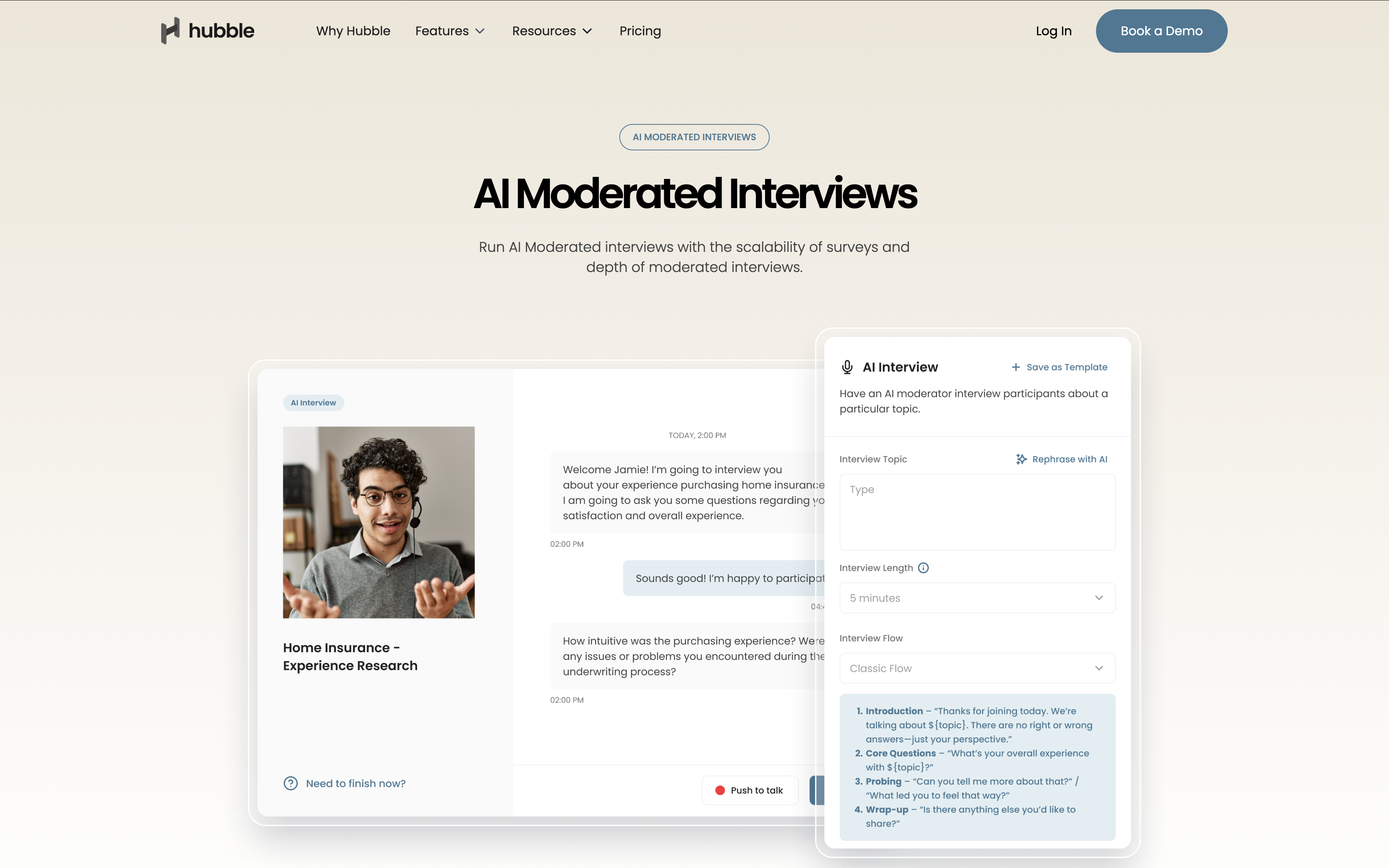
Hubble is a unified user research platform that offers AI Moderated Interviews alongside prototype testing, unmoderated studies, card sorting, and in-product surveys. What sets it apart from tools built only for AI interviews is that all of these methods live in one platform, so an AI-moderated conversation can sit next to a prototype test or a survey in the same research program, drawing qualitative and quantitative data from the same participants.
The AI moderator runs the conversation on its own and asks its own follow-ups, and researchers shape its direction through a customizable Discussion Guide. Recruitment runs through User Interviews and Respondent, which covers both B2C and B2B audiences, and once a study wraps, Hubble transcribes the sessions and generates summaries automatically. Video and audio analysis are available across the rest of the study as well.
📌 Key Features & Highlights
- AI Moderated Interviews with an AI moderator that adapts and probes in real time
- Customizable Discussion Guide to direct each interview
- AI interviews that run alongside prototype testing, card sorting, and surveys in one platform
- Automatic transcription, summaries, and video analysis
- Participant recruitment via User Interviews and Respondent
💰 Pricing
- Free version available
- Custom pricing for enterprises
⭐ Reviews (from G2)
- 4.7/5.0 (49 reviews)
📝 Summary
Hubble covers the essentials of AI-moderated interviews well, with a moderator that adapts in real time and synthesizes results once the session ends. Its real advantage shows when the interview is only one part of a broader study, since prototype tests, surveys, and unmoderated research all live on the same platform and draw from the same participants. For teams that want AI interviews without building a separate stack around them, Hubble is a strong place to start.


2. Maze
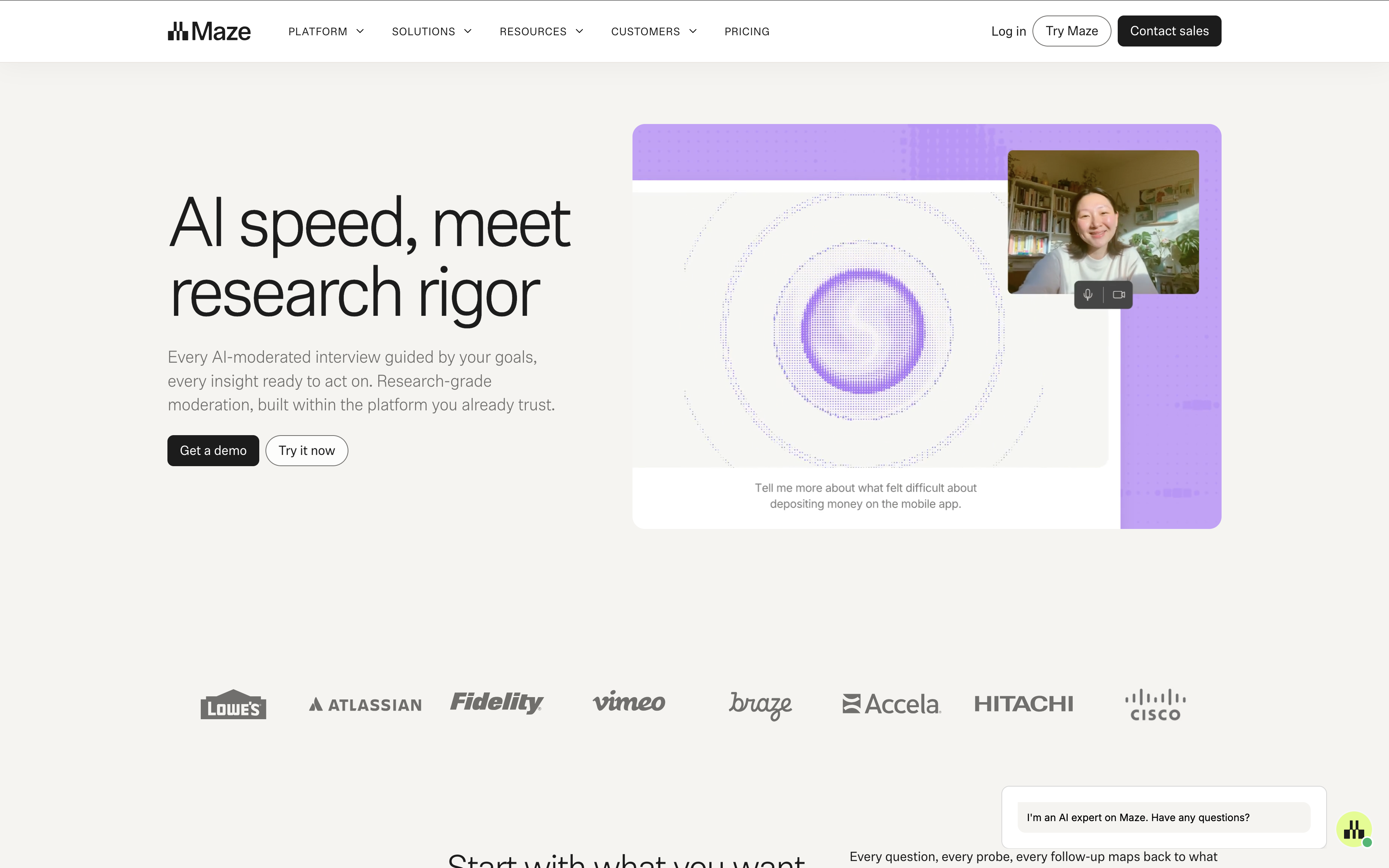
Maze is a product research platform that combines participant recruitment, study building, and analysis, with an AI Moderator added as a more recent feature. Maze positions it narrowly, for early-stage generative research at scale such as market research and problem discovery, rather than as a general-purpose interview tool, and it evaluates each conversation against 25 quality metrics to keep results consistent. Beyond the AI Moderator, Maze covers prototype testing, surveys, card sorting, tree testing, and live website testing, with recruitment through its own panel.
A couple of constraints are worth knowing before committing. The AI Moderator is sold only as an add-on to Maze's Enterprise plans, so smaller teams can't reach it without an enterprise contract. It also accepts only image files as stimuli, up to five JPEG or PNG images per study, so prototypes, live websites, and video stay out of scope inside the AI interview itself.
📌 Key Features & Highlights
- AI Moderator positioned for generative research at scale
- 25 quality metrics applied to every conversation
- Prototype testing, surveys, card sorting, tree testing, and live website testing
- Participant recruitment through the Maze Panel
💰 Pricing
- Free version available
- AI Moderator offered as an add-on to Enterprise plans (custom pricing)
⭐ Reviews (from G2)
- 4.5/5 (111 reviews)
📝 Summary
Maze is an established platform, and its AI Moderator does well at the job it was built for, running generative interviews at scale. Two things shape who it fits. The feature is sold only as a paid Enterprise add-on, so reaching it means going through sales first, and because it accepts only images as stimuli, there's no way to test a working prototype or a live product inside the interview. For a team that wants to test a prototype in the same conversation, that's the gap to weigh.
3. Dscout

Dscout supports a wide range of methods, from usability testing and diary studies to intercepts, surveys, and moderated interviews, all under enterprise-grade security across ISO 27001, SOC 2, HIPAA, and HITRUST. Dscout AI Studio can draft a study from a research goal, a Figma prototype, or a URL, and let you query the results in plain language afterward. The AI Moderator is part of AI Studio, but Dscout is currently rolling it out through a waitlist rather than offering it as a generally available feature.
Dscout frames the AI Moderator around dynamic probing in unmoderated sessions, adding follow-up questions when an answer needs more, and it can also run a session without a live moderator. How far it is meant to replace a full human interview is not spelled out on the product pages, so teams buying primarily for dedicated AI interviews should confirm the current scope before committing.
📌 Key Features & Highlights
- AI Moderator within Dscout AI Studio, built to deepen unmoderated studies
- AI study drafting from a research goal, Figma prototype, or URL
- Broad method set including diary studies, intercepts, and usability testing
- Enterprise security across ISO 27001, SOC 2, HIPAA, and HITRUST
💰 Pricing
- Not publicly listed (enterprise pricing; AI is an add-on)
⭐ Reviews (from G2)
- 4.5/5.0 (184 reviews)
📝 Summary
Dscout has a large review base and a wide range of methods, so teams already using it pick up AI moderation without changing tools. For AI interviews specifically, the feature is framed to strengthen unmoderated studies rather than serve as a dedicated interview product, which matters if AI-moderated interviews are your main reason for buying.
4. Askable
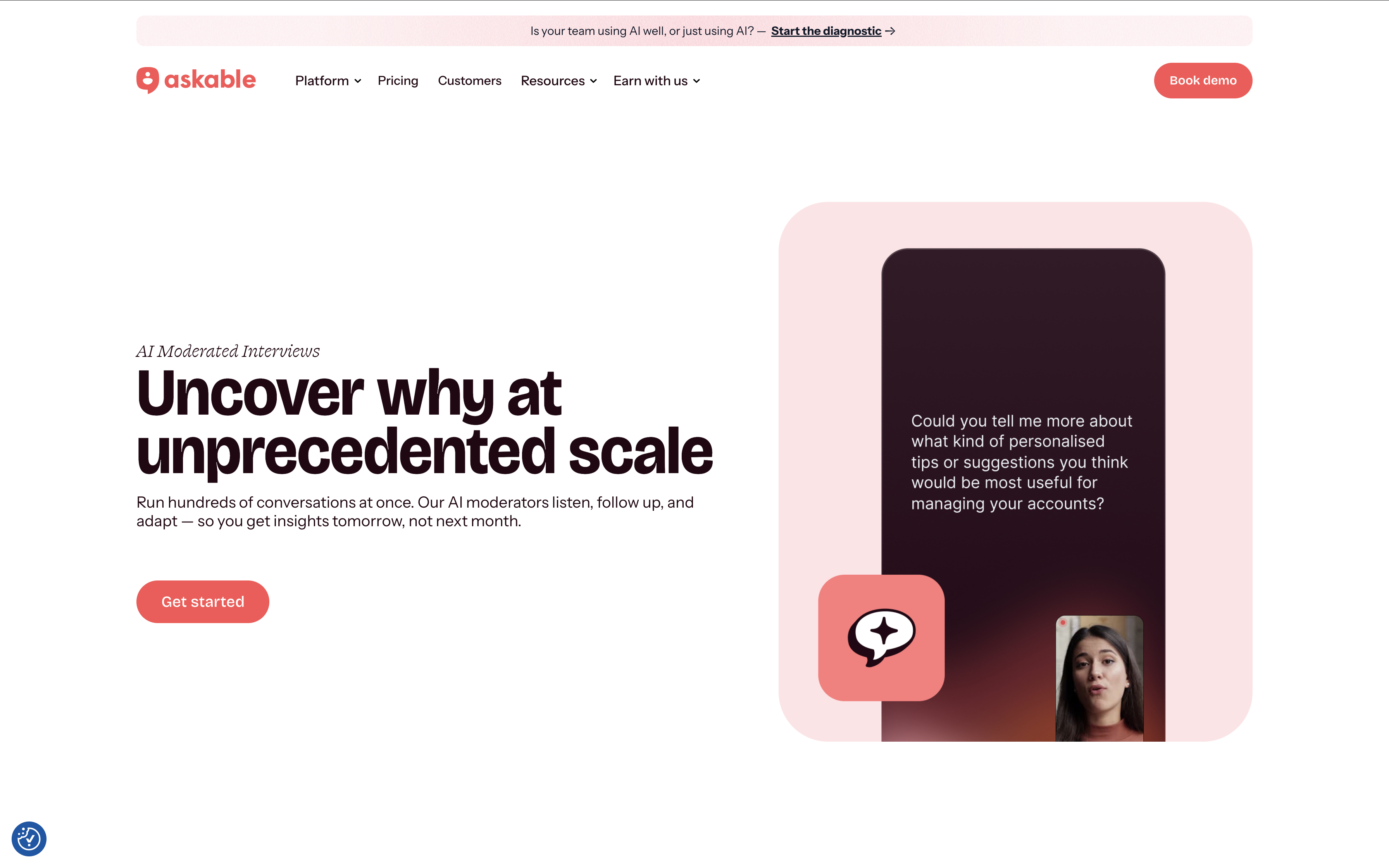
Askable is an all-in-one research platform spanning recruitment, moderated and unmoderated studies, and analysis, with AI Moderated Interviews among the methods it offers. The AI moderator carries many conversations at once, listening and following up as each one unfolds, and Askable pairs that with a vetted participant panel across 50+ countries, so finding people and talking to them happen in the same place. It also runs remote moderated sessions, surveys, card sorting, tree tests, and diary studies.
📌 Key Features & Highlights
- AI Moderated Interviews running many conversations at once
- Vetted participant panel across 50+ countries
- Remote moderated sessions for usability testing and discovery
- Surveys, card sorting, tree testing, and diary studies
💰 Pricing
- Not publicly listed (contact sales)
⭐ Reviews (from G2)
- 4.6/5 (50 reviews)
📝 Summary
Askable's review base sets it apart from the newer AI-only tools, most of which have little or no review history yet. Recruitment and a dependable panel have long been its strength, now paired with AI moderation in the same workflow. For teams that weigh participant access as heavily as the interview itself, that combination is the reason to look.
5. Great Question
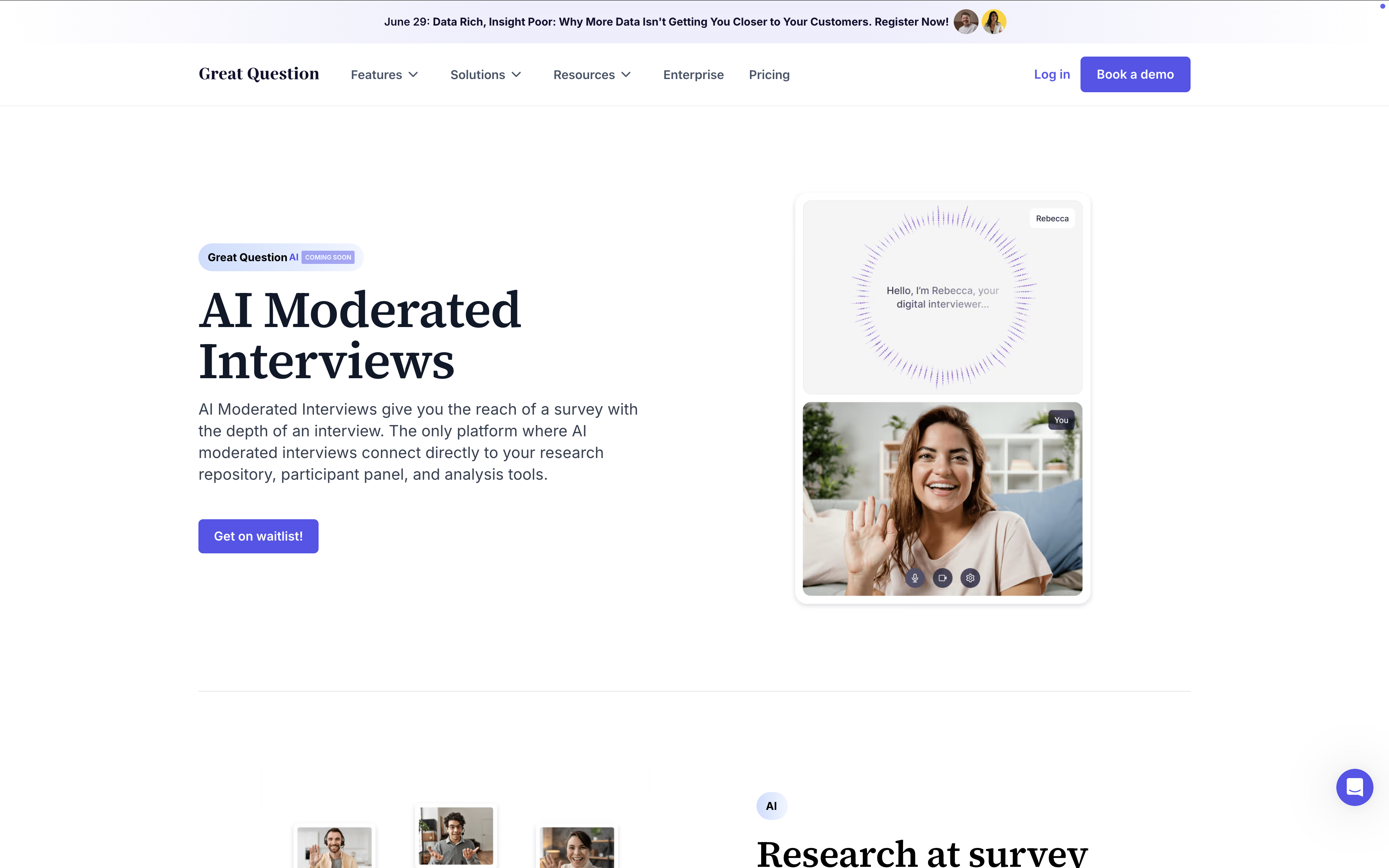
Great Question is an all-in-one UX research platform covering recruitment, interviews, surveys, prototype testing, and a research repository. Its AI Moderated Interviews feature is designed to plug into all of that, so an AI interview's transcripts and insights would land in the same repository and analysis tools a team already works in. Interviews run in dozens of languages, and the platform's wider AI can query large studies of up to 50 hours of transcripts.
There's one timing qualification to factor in. As of mid-2026, AI Moderated Interviews is still in beta and only open through a waitlist, so a team that needs AI moderation running in production today cannot count on it yet.
📌 Key Features & Highlights
- AI interviews designed to connect to the research repository, panel, and analysis tools
- Interviews in dozens of languages with automatic transcripts
- Repository-wide AI that can query up to 50 hours of transcripts
💰 Pricing
- Free trial available
- Paid and enterprise plans
⭐ Reviews (from G2)
- 4.7/5.0 (22 reviews)
📝 Summary
The appeal here is integration. AI interviews feed straight into the panel, repository, and analysis a team already relies on. Since the feature is still in a beta waitlist rather than generally available, anyone who needs AI moderation working this quarter should confirm access first.
6. Conveo

Conveo takes a video-first approach to AI research, aimed at mid-market and enterprise teams. Its AI interviewer runs asynchronous voice or video interviews across 50+ languages, and the analysis goes further than most. Conveo reads voice, video, tone, and behavior together, then ties what it finds back to verbatim quotes and the original clips. Recruitment stays flexible through CSV lists, external panels, QR codes, or messaging invites, and the platform runs from study design through to a reusable insight library.
📌 Key Features & Highlights
- Video-first AI interviews in 50+ languages
- Multimodal analysis of voice, video, tone, and behavior, tied to quotes and clips
- Flexible recruitment via CSV, external panels, QR codes, or messaging
- End-to-end workflow from study design to insight library
💰 Pricing
- Not publicly listed; third-party buyer guides put the Enterprise tier at around $45,000/year, billed as prepaid credits by interview minutes
⭐ Reviews (from G2)
- 5.0/5.0 from only 2 reviews, too small a sample to read much into
📝 Summary
Conveo's draw is the depth of its analysis. The video-first format and the reading of tone and behavior suit brand and consumer research, where how something is said matters as much as what. The enterprise pricing and thin review base point the same way, toward organizations running continuous qualitative work rather than teams just getting started.
7. Strella

Strella centers on AI-moderated interviews paired with real-time synthesis, and its most distinctive trait is the freedom to choose who moderates. You can let the AI run the interview or step in and moderate it yourself, and both kinds of session live together in one place. Interviews run in 46+ languages on desktop or mobile, with follow-ups that adapt as the conversation moves, and recruitment draws on Strella's panel or your own participants.
📌 Key Features & Highlights
- Choice of AI or self-moderated interviews in one platform
- Real-time synthesis with highlight reels and a chat-with-your-data feature
- Interviews in 46+ languages on desktop or mobile
- Recruitment via Strella's panel or your own participants
💰 Pricing
- Not publicly listed (contact sales / demo)
⭐ Reviews (from G2)
- 5.0/5.0 (4 reviews)
- Still a small base, but reviewers highlight the time saved and the AI running sessions on its own
📝 Summary
Strella suits teams that want AI interviews but still run human-moderated sessions, since the two sit side by side. Reviewers point to the time it saves and the way the moderator handles sessions on its own. One reviewer also made the fair point that not everyone wants to talk to an AI rather than a person, so it works best with the occasional face-to-face session in the mix.
8. Outset
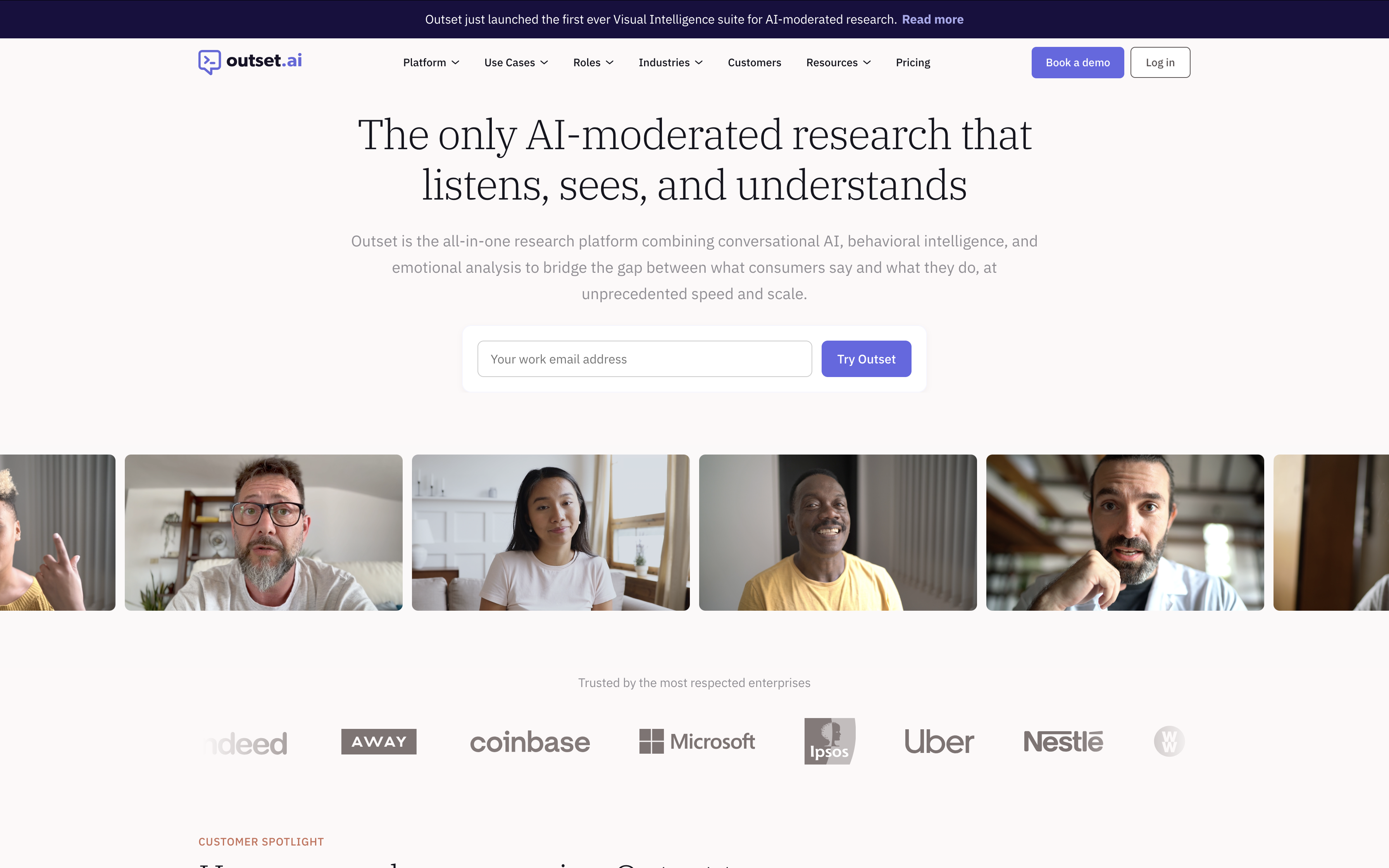
Outset runs one-on-one qualitative interviews at scale for product, UX, and research teams, and it leans on multimodal probing to do it. The moderator pays attention to more than words, following click paths and reactions as the conversation goes, and a single study can mix in quantitative questions like Likert scales, matrix, and ranking exercises alongside the open-ended probing. Interviews run asynchronously across time zones in over 40 languages, recruitment comes through built-in panel partners or your own list, and transcripts, summaries, and themes are generated automatically once a session ends.
📌 Key Features & Highlights
- Multimodal probing based on what participants say and do
- Qualitative and quantitative questions combined in one study
- Asynchronous one-on-one interviews across time zones in 40+ languages
- Automatic transcripts, summaries, and themes
💰 Pricing
- Not publicly listed; plans are quoted on request (contact sales)
⭐ Reviews (from G2)
- No reviews yet on G2
📝 Summary
Outset works well for teams that want qualitative depth at scale, particularly research that blends survey-style questions with conversational follow-up. It is shaped for mid-sized and enterprise teams running ongoing programs rather than the occasional one-off study. Public reviews aren't there yet, so its enterprise case studies are the main outside signal for now.
9. Listen Labs
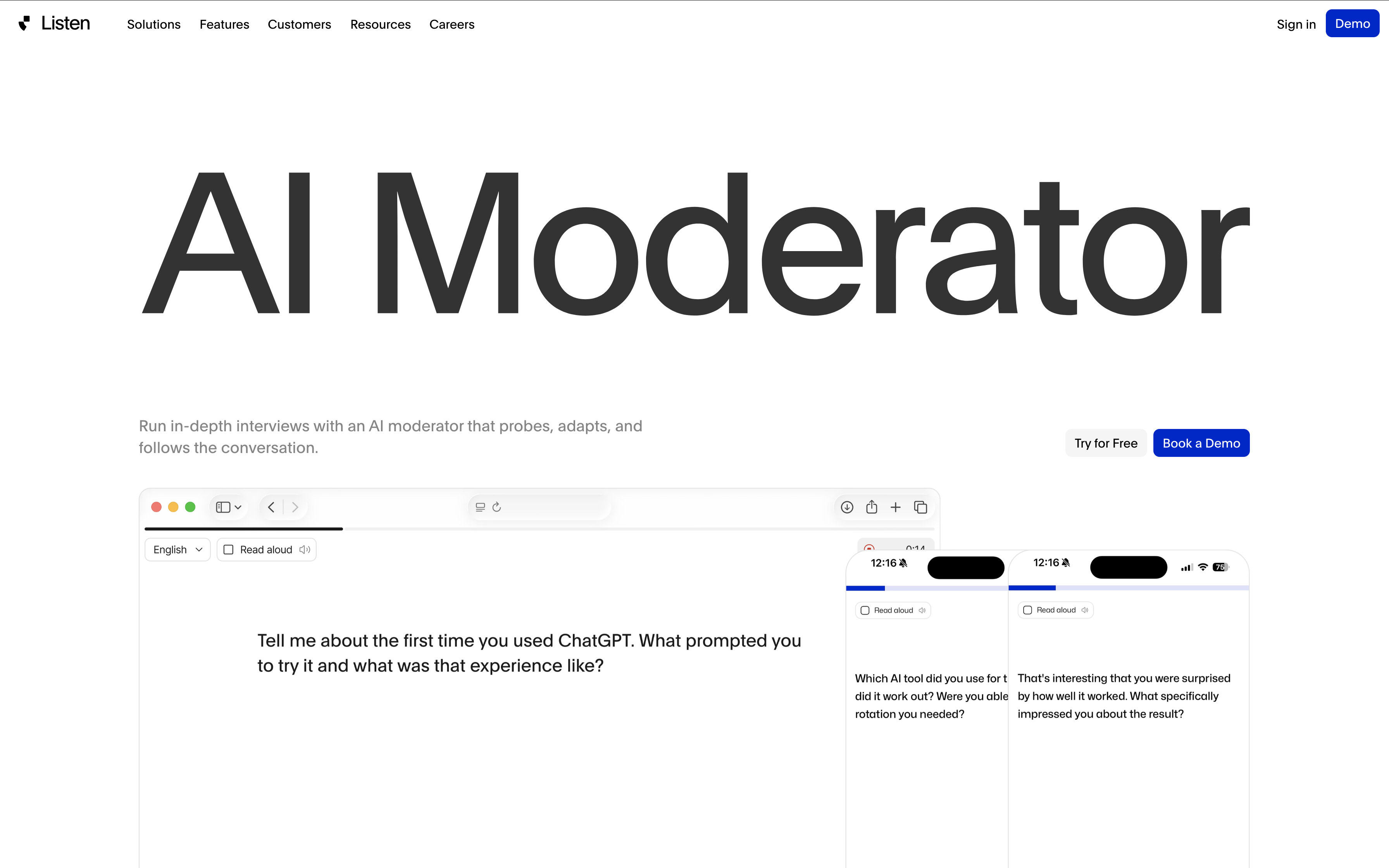
Listen Labs is built around AI-moderated interviews from end to end, positioned to take the place of surveys, focus groups, and manual interviews. Scale is where it stands out. It pulls from a built-in panel of 30M+ participants, runs interviews by video, audio, or text, and translates and transcribes across 100+ languages. Videos, images, and Figma prototypes all work as stimuli, and once a study finishes, Listen Labs turns it into an executive-ready report complete with key themes, highlight reels, and slide decks.
📌 Key Features & Highlights
- Built-in panel of 30M+ participants
- Video, audio, or text interviews across 100+ languages
- Videos, images, and Figma prototypes supported as stimuli
- Automated reports with key themes, highlight reels, and slide decks
💰 Pricing
- Not publicly listed (free trial available; contact sales for a demo)
⭐ Reviews (from G2)
- No reviews yet on G2
📝 Summary
Listen Labs has raised $100M to date, and that backing comes through in the panel size and the reach of its reporting. It is made for consumer and brand research at volume, so the teams that get the most from it are the ones running large, continuous studies rather than the occasional interview.
10. Userology

Userology is an AI-moderated platform built specifically for usability and evaluative research, and its standout trait is vision-aware moderation. Because the AI can see on-screen interactions, it catches hesitation or friction in the moment and asks follow-ups tied to what the participant is actually doing, not just what they say out loud. Its moderator, Nova, drafts discussion guides and tests web, iOS, Android, and Figma in real time, drawing on a panel of 15M+ participants.
📌 Key Features & Highlights
- Vision-aware moderation that observes on-screen interactions
- Testing across web, iOS, Android, and Figma
- AI-drafted discussion guides and UX metrics like success rates and task time
- Panel of 15M+ participants
💰 Pricing
- Not publicly listed (custom; contact sales)
⭐ Reviews (from G2)
- 5.0/5.0 (1 review)
- Too little to read much into, and that one review is about participant recruitment rather than the AI moderator
📝 Summary
Userology is a strong fit for evaluative research where seeing the screen matters, like testing a prototype or a live product, which separates it from voice-only AI interviewers. For teams running international studies, language coverage is the thing to confirm up front, which the site puts at 40+ where we checked.
11. Perspective AI
Perspective AI runs AI-moderated interviews by voice or text, building a study from a prompt and then conducting the conversations and pulling the findings together. It draws on templates for common goals like churn, win-loss, and persona research, and reports come back grouped into themes and quotes. One thing to set expectations on is its breadth. Perspective AI extends well past UX research into lead qualification, onboarding, and customer experience, so it is a wider conversational-AI tool that does research interviews rather than a research-only platform.
📌 Key Features & Highlights
- AI-moderated interviews by voice or text, generated from a prompt
- Templates for churn, win-loss, and persona research
- Theme and quote synthesis with summary reports
- SOC 2 Type II and ISO 27001 certified
💰 Pricing
- Free tier available
- Paid and enterprise plans (contact sales)
⭐ Reviews (from G2)
- 5.0/5.0 (2 reviews)
- Too few to read much into
📝 Summary
Perspective AI brings strong security credentials in SOC 2 Type II and ISO 27001, and its free tier keeps the barrier to entry low. Because its reach runs across customer experience and lead generation rather than UX research alone, a team that wants a tool built purely for research interviews should factor that breadth in.
12. Genway

Genway runs AI-moderated user interviews through an AI interviewer it calls Rebecca, aimed at product and market research teams. Participants answer by voice or text, and what gives Genway its character is the analysis that follows. Rather than stopping at a transcript, it reads speech emotion and facial expression, then auto-tags and themes the results. Genway also runs AI-moderated usability tests on Figma prototypes and adaptive surveys, and it is available through AWS Marketplace.
📌 Key Features & Highlights
- AI interviewer (Rebecca) running voice or text interviews with adaptive follow-ups
- Speech emotion recognition and facial expression detection
- Automatic tagging, theming, and real-time summaries
- AI-moderated usability testing on Figma prototypes
💰 Pricing
- Free trial available; no public pricing (also offered via AWS Marketplace)
⭐ Reviews (from G2)
- No reviews yet on G2
📝 Summary
Genway's draw is the analysis layer it adds on top of interviews, picking up tone and expression rather than words alone, which suits teams that want more signal than a transcript gives. There isn't much third-party review history yet, so a trial is the most reliable way to judge whether it fits.
13. Versive

Versive is an AI-first research platform that folds AI moderation, quantitative and qualitative questions, and usability testing into a single study. Its synthesis stays tied to the source, producing reports whose citations link back to the underlying transcripts, and you can question your study data afterward and get answers backed by specific quotes. One option in particular sets it apart. Alongside testing with real recruited participants, Versive can run studies with AI personas, synthetic participants generated from your own users, so a team set on feedback from real people should be deliberate about how a study is configured.
📌 Key Features & Highlights
- AI moderation, quant and qual questions, and usability testing in one study
- Option to test with real users, AI personas, or both
- Reports with citations that link back to source transcripts
- Querying of study data with quote-backed answers
💰 Pricing
- Not publicly listed (contact sales / demo)
⭐ Reviews (from G2)
- No reviews yet on G2
📝 Summary
Versive suits teams that want interview-level depth without running full interviews, and its citation-backed synthesis speeds up the reporting that usually drags. The AI-persona option is a real differentiator, and it also means a team focused on real-user research should be clear about which mode a given study runs in.
14. ResearchGOAT
ResearchGOAT runs live AI-moderated qualitative interviews and handles the work around them, from building the discussion guide to recruitment and analysis. Its AI interviewers work in any language and can run with several participants at once, and the results feed into an analysis dashboard once interviews wrap. The pitch is in-depth qualitative research at a fraction of what traditional methods cost.
📌 Key Features & Highlights
- Live AI-moderated interviews in any language
- Discussion-guide creation, recruitment, and analysis in one flow
- Multiple simultaneous interviews
- Insights dashboard for analysis
💰 Pricing
- Free tier with one project and 360 AI interview minutes
- Usage-based pricing after that
⭐ Reviews (from G2)
- No reviews yet on G2
📝 Summary
ResearchGOAT is worth a look for teams that want to try AI moderation before paying for it, since the free tier covers a full project. It is a smaller, newer platform with little review history so far, so that free project is the natural way to see whether it holds up for your work.
15. Typeform (Research Flow)

Typeform made its name on conversational forms and surveys, and in June 2026 it moved into AI interviews with Research Flow. The idea builds naturally on what it already does well. Teams can run AI-moderated studies at survey scale across text, voice, and video, reaching hundreds of participants at once, while those participants get the polished Typeform experience they already know rather than a generic interface. Research Flow handles the study design, recruitment, interviews, and synthesis, with transcription, theme extraction, and sentiment scoring built in.
Since it only arrived in June 2026, Research Flow has little track record so far, and it sits inside Typeform's wider forms-and-workflows product rather than standing alone as a research platform. For a team already on Typeform that is a convenience. For one choosing a tool purely for AI interviews, the newness is worth keeping in mind.
📌 Key Features & Highlights
- AI-moderated studies across text, voice, and video at survey scale
- The familiar Typeform participant experience
- Automatic transcription, theme extraction, and sentiment scoring
- Built-in study design and participant recruitment
💰 Pricing
- Free plan available
- Paid Business and Growth tiers; Research Flow is not priced separately (contact sales)
⭐ Reviews (from G2)
- 4.5/5.0 (roughly 1,000 reviews)
- Those reviews are for Typeform's form and survey product, not Research Flow, which has no reviews yet
📝 Summary
Research Flow is a credible step from a company that already understands conversational data collection, and handing participants the familiar Typeform experience is a genuine plus for response quality. The caveat is maturity. It launched in mid-2026 inside a larger forms platform, so a team weighing it for AI-moderated interviews specifically is looking at something very new rather than proven.
Why AI moderated interview tools matter
Qualitative research has always been a slow process for product and UX teams. Running in-depth interviews requires a moderator who can only conduct so many sessions in a day before fatigue starts affecting follow-up quality. Add in recruitment, scheduling, no-shows, and reschedules, and a single qualitative study can stretch into weeks rather than days.
Cost is the other constraint. Participant recruitment, incentives, moderator time, transcription, and analysis all need to be budgeted for, and for a study of ten to fifteen participants that adds up quickly, with B2B and specialized audiences pushing toward the higher end.
AI moderated interview tools shift this equation. Teams can run many interviews in parallel rather than scheduling them one by one, and transcription and first-pass theming happen automatically. For research areas like concept testing, messaging evaluation, and post-launch feature feedback, AI moderation can deliver comparable insights at a fraction of the cost and time.
It has its limits, though. Adaptive probing has improved over the past year, but conversations carrying emotional weight, cultural nuance, or sensitive subject matter still benefit from a human moderator who can read silence, hesitation, or a shift in tone. Health research, grief work, regulated industries, and topics involving harm are still better left to human researchers. Most product teams that adopt AI moderation use it for standardized work and keep human moderators for the conversations that need them.
How to choose the right AI moderated interview tool
Most of these tools cover the basics in similar ways. They run adaptive AI interviews, transcribe automatically, and surface themes afterward. What separates them is harder to see from a feature list, and it comes down to how a tool fits the research you already do.
The question that matters most is whether the AI interview connects to the rest of your research. A tool built only for AI interviews handles the conversation well, but it stops there. The moment you also need a prototype test, a card sort, or an in-product survey, you are opening a second tool, recruiting a second time, and joining the data together by hand. If AI interviews are one part of how your team works rather than the only method, that connection matters more than any single interviewing feature.
Recruitment sits close behind. Some tools bring their own panel, some connect to platforms like User Interviews and Respondent, and some leave you to supply your own list. A study is only as good as the people in it, so if you do not already have a steady way to reach the right participants, how a tool handles recruitment carries real weight.
The last thing to check is more practical. Several of the larger platforms have announced AI moderation that is still in beta or open only through a waitlist, and the feature pages can read as finished even when the feature has not shipped. A team that needs to run interviews this quarter should confirm that a tool's AI moderation is generally available rather than just announced, and that the plan they are looking at actually includes it, since AI moderation is sometimes gated behind a top enterprise tier or sold as a separate add-on.
Choosing the right tool for your team
The right choice depends on what the rest of your research looks like. For a team that runs AI interviews as one method among several, a unified platform tends to be the better fit, since keeping interviews, prototype tests, surveys, and unmoderated studies together avoids the cost and friction of holding a separate tool for each. This is where Hubble sits, with AI Moderated Interviews built into a platform that already covers the rest of the research process, along with recruitment through User Interviews and Respondent.
More specialized work can point elsewhere. Research that leans on tone and reaction, or that depends on watching the screen as someone works, may be served better by a focused tool built around that one thing. Teams already invested in a mature, broader platform may prefer to pick up AI moderation without switching, as long as its availability fits their timeline. There is no single answer, but the tools that hold a place in a team's workflow over time tend to be the ones that fit how the team already works, not the ones with the longest feature list.
Additional resources
- To learn more about otherUserTesting alternatives, check out 13 best UserTesting alternatives.
- To see our curated list of survey tools, see the best survey tools for research in 2026.
- To learn more about top UXR tools, please see the best user research tools in 2026.
- To see our curated list of prototype testing tools, see the 11 best prototype testing tools.
FAQs


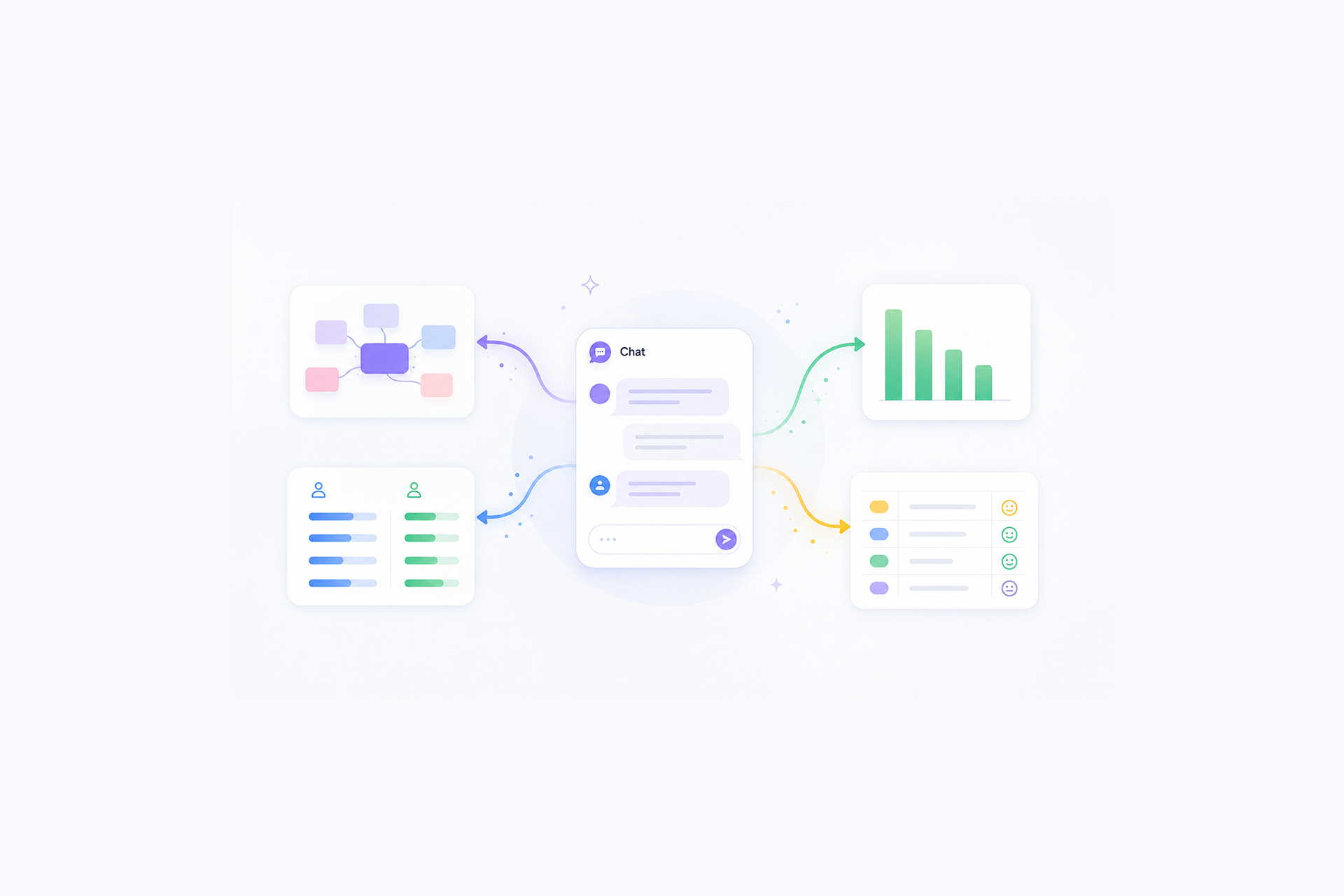
An AI moderated interview is a qualitative interview run by an AI rather than a human moderator. The AI asks the questions, listens to each answer, and decides its own follow-ups in real time, so the conversation adapts to what the participant says instead of following a fixed script. Sessions usually run asynchronously, which lets many interviews happen at once across different time zones, and most tools transcribe and summarize the results automatically once a session ends.
Not always. Several established research platforms have announced AI moderation that is still in beta or open only through a waitlist, and the feature pages can read as finished even when the feature has not shipped. Before committing to a tool for AI interviews, confirm two things: that its AI moderation is generally available rather than just announced, and that the plan you are looking at actually includes it, since some platforms gate it behind a top enterprise tier or sell it as a separate add-on.
AI moderation fits standardized, higher-volume work well, like concept testing, message evaluation, or post-launch feature feedback, where you want depth across many participants without scheduling each session by hand. A human moderator is still the better choice when a conversation carries emotional weight, cultural nuance, or sensitive subject matter, since reading silence, hesitation, or a shift in tone is hard to automate. Many teams run both, using AI for the repeatable studies and keeping human researchers for the conversations that need them.
Start with how the AI interview connects to the rest of your research. A tool built only for interviews handles the conversation well, but the moment you also need a prototype test, a card sort, or an in-product survey, you are opening a second tool and joining the data by hand, so workflow fit often matters more than any single interviewing feature. Recruitment is the next thing to weigh, since some tools bring their own panel, some connect to platforms like User Interviews and Respondent, and some leave you to supply your own list. From there it comes down to what your study actually needs, whether that is seeing the screen as someone works, reading tone and reaction, or simply running at volume.


.png)